
Friday, December 25, 2015
වෙළන් [Welang]/Fishing rod tree (Pterospermum suberifolium)


Thursday, December 24, 2015
දිය තිප්පිලි/දිය බුලත්[Diya tippili/Diya bulat]Shiny bush/Pepper elder/Pansit (Peperomia pellucida)

Wednesday, December 23, 2015

Tuesday, December 22, 2015
Calopo (Calopogonium mucunoides)

Monday, December 21, 2015
පෙති තෝර[Peti tora]/Pot cassia/Sickle senna (Senna tora [Cassia tora])

Sunday, December 20, 2015
කන්කුන්[Kan-Kun](Ipomoea aquatica)

Saturday, December 19, 2015
කොළ-හඟල, හීන්-වේවැල්[Kola-Hangala, Heen-Wewel](Calamus pseudotenuis)

Friday, December 18, 2015
Butterfly-pea (Centrosema pubescens)

Thursday, December 17, 2015
Thalassodes spp.

External Links - http://www.inaturalist.org/taxa/82746-Thalassodes
Reference - The Lepidoptera of Ceylon - F. Moore, F.Z.S. Vol 3 Page 426-427 & Plate 194-195
Wednesday, December 16, 2015
දිය ගෝවා[Diya gova]/Yellow velvetleaf (Limnocharis flava)

Tuesday, December 15, 2015
සියඹලා[Siyabala]/Tamarind/Indian Date (Tamarindus indica)

Monday, December 14, 2015
කහ තැල් කොළ[Kaha Tel Kola]/Ivy woodrose(Merremia hederacea)

Sunday, December 13, 2015
Epithema ceylanicum [Epithema carnosum]

Saturday, December 12, 2015
Wallace's Swift (Borbo cinnara)

Friday, December 11, 2015
Heliotropium curassavicum

Thursday, December 10, 2015
වල්පිච්ච/ගැටපිච්ච [Walpichcha/Getapichcha]Downy jasmine (Jasminum multiflorum)

Wednesday, December 9, 2015

Tuesday, December 8, 2015
Shrubby false buttonweed (Spermacoce verticillata)

Monday, December 7, 2015
දේවකගේ තැලි කටුස්සා [Devakage Theli Katussaa]/Devaka's Fan-throated Lizard (Sitana devakai)
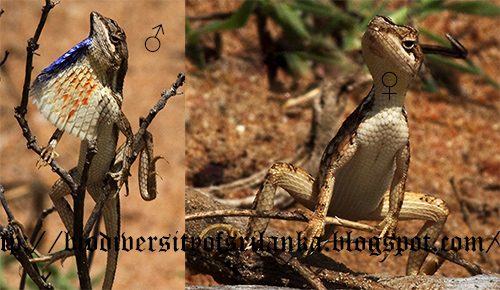
Fan throated Lizard inhabiting dry coastal areas of the North, Northwestern and Southeastern part of the country was formerly considered as a single species Sitana ponticeriana which is also recorded from the India. However with the recent taxonomic changes now it is considered that Sri Lanka is home to two distinct endemic species, one occurs in the Southeastern coastal areas (Sitana bahiri) and other in the Northern and Northwestern part of the island (Sitana devakai).
Devaka's Fan-throated Lizard is an endemic lizard confine to the dry coastal areas of the north and north western part of the island. However sometime it is recorded even 10-60 km from the nearest beach. It is active during the day time. Territorial behaviors of Sitana devakai are similar to its Southeastern congener Sitana bahiri.
References:
Amarasinghe, A.A.T., Ineich I., Karunarathna D.M.S.S., Madhava W., Botejue S. & Campbell P.D., 2015 Two new species of the genus Sitana Cuvier, 1829 (Reptilia: Agamidae) from Sri Lanka, including a taxonomic revision of the Indian Sitana species, Zootaxa 3915(1): 67-98
Sunday, December 6, 2015
කෙතල/කෙටල[Kethala/Ketala] (Lagenandra praetermissa)

Subscribe to:
Comments (Atom)