Friday, January 31, 2014

Spot-winged Thrush/ශ්‍රී ලංකා තිත්පිය තිරාසිකයා/පුල්ලි වල් අවිච්චියා [Sri Lanka Titpiya Thirasikaya/Pulli Wal Avichchiya] (Geokichla spiloptera)

A rare breeding resident inhabiting undergrowth of forests and well wooded areas from wet lowlands to higher hills. Scarce and local in riverine forests in the dry zone. It feeds on insects, worms, etc mainly on the ground, skulking in the undergrowth while turning over leaf litter. It lives as pairs or as solitary birds. The breeding season is from March to April and again from August to September. It build a nest - an untidy mass of twigs, moss and grass- placed in a crown of tree fern or fork of a sapling where it lays two eggs. 

සිංහලෙන් කියවන්න >>

Wednesday, January 29, 2014

Aphyllorchis montana

A rare leafless terrestrial saprophytic orchid species with distinguish purple stem. It grows under the shade of trees in the submontane or mid-country tropical wet evergreen forests below 610 m altitude. 

Sunday, January 26, 2014

First physical observation of Petinomys fuscocapillus (jerdon, 1847) with photographic evidence from Sinharaja World Heritage Site

 Small flying squirrel or Heen Hambawa (හීන් හම්බාවා) in Sinhalese is one of the rarest nocturnal mammals of heavy forests of the lower foothills to higher altitudes (Yapa A. & Ratnavira G., 2013). As per Phillips W.W.A. its range limited to the hills at medium altitudes with extremely local distribution (Phillips W.W.A., 1981). Further he has given a list of places from where it had been recorded up to then (Table 1). Other than Sri Lanka it is found only in Western Ghats of India and there also it was re-discovered in a coconut grove in Kerala state in 1989 after one hundred years and it was thought to be extinct in India till then (Yapa A. & Ratnavira G., 2013 & Nanayakkara et.al., 2012 quoting Kurup, 1989).  In 2007 Jayasekara et.al. recorded it from Sinharaja forest with a black & White picture captured by a camera trap placed on a fruiting tree to assess fruit consumption by birds and mammals of a tropical rain forest (Jayasekara et.al., 2007).  Most recent observation of it is from Laggala-Illukkubura road of Knuckles range made by Nanayakkara et.al on 26th January 2013. They have observed and photographed a single specimen while it was feeding on tender part of the shoot and leaves of a climber at 2130 hr on a tree 9m above ground level in a well-developed semi-evergreen forest habitat .  They have not observed gliding of the animal (Nanayakkara et.al, 2013). Hitherto only color photographs available of this illusive mammal was from them and it was the first physical examination of this species from Sri Lanka after 78 years.  


Location
Altitude (ft)
1
Forests of Dimbula (in 1850s)
4500
2
Dickoya

3
Gammaduwa in the east Mathale hills
2500ft
4
Kitulgala
900
5
Wellawaya
600
6
Adam’s peak wilderness

Food:
It is believed that Small flying squirrel is feeds on wild fruits, berries, nuts, shoots and young leaves and possibly also sappy bark of certain trees (Phillips W.W.A., 1981)

Habits:
Small flying squirrel is purely nocturnal and arboreal and it spends day time in a hole of a tree trunk or branch of a large tree. It carries its tail curled over its back when stationery and feeding. Not much information available on its breeding and it is said that two young are born in a hole, lined with vegetable fibres, etc. in which their mother lives day hours.

Observation and discussion
On 14th January 2014 we were able to observe and photograph a Small flying squirrel at a place close to the Sinharaja forest reserve (Outside the protected area) from around 11.30 PM to 3.00AM of 15th January 2014 (It was not at the site continuously during the observation period but appeared there time to time). It was observed about 2m above the ground while feeding probably on young shoots and leaves of a mango tree (Mangifera indica). Short distance (less than 3m) gliding also noticed at least once during the observation period.  Most of the time except when moving from one place to another it kept its tail draped over its back. It was not much shy and not paid much attention toward camera flashes and torch lights. According to all available published data this might be the second instance of the physical observation of this rare mammal in recent history with photographic evidences and first instance of observing it in Sinharaja forest reserve area though existing of it there has been already proved with camera traps (Jayasekara et.al., 2007). Most important fact here is that this observation was made not inside the dense forest but small secondary forest area close to Kudawa conservation center office and this observation highlights the  important of conserving not only Sinharaja forest itself but also buffer zone forest areas surrounding the Sinharaja heritage site.


References


Kurup G.U., 1989 Rediscovery of small Travancore Flying Squirrel. Oryx 23: 2-3


Phillips W.W.A., 1980 Manual of the mammals of Sri Lanka Part 2: 175-177 

Weerakoon D. K. 2012. The Taxonomy and Conservation Status of Mammals in Sri Lanka. In: The National Red List 2012 of Sri Lanka; Conservation Status of the Fauna and Flora. Weerakoon, D.K. & S. Wijesundara Eds.,Ministry of Environment, Colombo, Sri Lanka 134-144pp

Yapa A. and Ratnavira G. 2013 The Mammals of Sri Lanka 212-213

Saturday, January 25, 2014

Hump-nosed Lizard/Lyre-headed Lizard/ගැටහොඹු කටුස්සා/කරමල් බෝදිලිමා/බොහොඬා[Gatahombu Katussa/Karamal Bodilima/Bohonda](Lyriocephalus scutatus)

Hump-nosed Lizard is an endemic arboreal lizard found in shaded forests and adjoining well wooded home gardens and plantations from wet lowlands to mid hills (up to about 1600m a.s.l.). It feeds on insects[termites, butterflies, moths], earthworms,  young shoots and buds as well as fruits on both trees and on land. It is a diurnal lizard and during night ascending high up trees to sleep. If cornered it opens its mouth wide to show the bright red color inside, change body color  and also practicing death feigning. 


Thursday, January 23, 2014

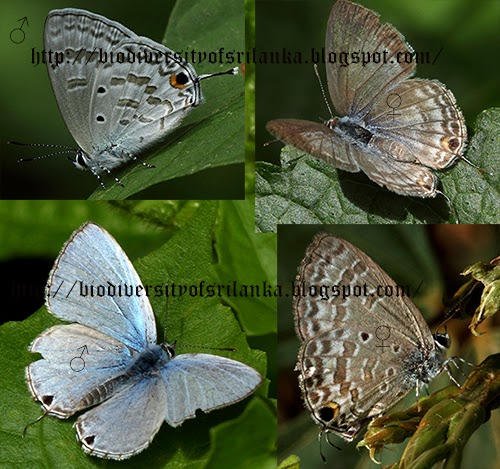
Plain Hedge Blue (Celastrina lavendularis)

Plain Hedge Blue is a rare butterfly found in up country over 3000ft between February and October (Woodhouse L.G.O., 1950). However above specimen was photographed in the Sinharaja World Heritage Site (~1700ft). No records available on its larval food plant or early stages of the life cycle.

Wednesday, January 22, 2014

රන් දෝතළු[Ran dothalu] (Loxococcus rupicola)

Ran dothalu is a rare endemic palm confine to the  south-western rain forests from lowlands to hills (300 to 1500m a.s.l.). It can be found as small populations on shady rocky outcrops  near streams. Seeds use as a substitute for Betel-nut palm for mastication with betel. This palm recently become  a popular ornamental plant and despite the fact that it is protected under the law, illegal over exploitation widely practices and hence become an endangered plant.


Monday, January 20, 2014

Frogmouth/මැඩිමුහුණා[madimuhuna] (Batrachostomus moniliger)

Frogmouth is a rare breeding resident found in dense forests and forests edges in all climatic zones while scarce in hills and comparatively common in the wet zone.  It is a strict nocturnal bird and spends the day perch across a branch with beak pointing upwards and the facial plumes erected forwards looking rather like a broken branch. It feeds mainly on insects like beetles. The breeding takes place from January to March and again from August to September. The nest is a small pad set on a horizontal branch, well camouflaged with lichens and barks which support a single egg which is brooded during the day by the male bird (probably the female broods at night - (Henry G.M., 1998))


Saturday, January 18, 2014

බෝවිටියා [Bowitiya] (Osbeckia parvifolia)

An indigenous prostrate to ascending herb common in grasslands, open areas, among rocks and along roads in montane zone. Flowering throughout the year.

Thursday, January 16, 2014

Tailless Lineblue (Prosotas dubiosa indica)


Common butterfly found in forests and such well wooded areas throughout the island. Male settles frequently on damp earth to absorb minerals. Larva feeds on Senegalia caesia (හිඟුරු වැල්)Dalbergia rostrata, Mimosa diplotricha (Giant sensitive plant/Creeping mimosa)Mimosa pudica (නිදිකුම්ඹා/Sensitive plant/Touch-me-not)Albizia odoratissima (සූරිය මාර), Pithecellobium dulce (මැනිලා සියඹලා/Madras thorn/Manila Tamarind), Samanea saman (මාර/පිනි මාර/පාරෙ මාර/Rain tree) and Allophylus cobbe (බූ-කොබ්බෑ\කොබ්බෑ).

Monday, January 13, 2014

Lobelia heyneana

An indigenous annual herb common in shady and moist places of  hill country. Flowering January to October.

Sunday, January 12, 2014

Kelaart's Dwarf Toad/කෙලාර්ට්ගේ කුරු ගෙම්බා[Kelaartge Kuru Gemba] (Adenomus kelaartii)

Kelaart's Dwarf Toad is an endemic frog inhabiting wet zone forests and adjoining well wooded areas from lowlands to sub-montane region. It is a terrestrial species though occasionally climbs on trees and walls of the rural houses. Kelaart's Dwarf Frog active mainly during the night and in the day time it hides under rocks, decaying logs and  among leaf litter along stream banks. Sometimes more than one individuals can be seen hiding together in a same rock crevice.


Friday, January 10, 2014

Wednesday, January 8, 2014

New distribution record for Libellago corbeti (van der Poorten, N., 2009)


Introduction

Libellago corbeti (Ebony Gem) is an endemic damselfly first identified in July 2007 from two male specimens seen near Kudawe and later on another two females from same locality in April 2008. It was described as a new species by Nancy van der Poorten in 2009 (van der Poorten, N., 2009). Additional sightings of it from the type locality as well as from several other forests of the south western wet zone were recorded subsequently (van der Poorten, N., 2011). Those additional places are -
1)      Near the start of the Moulawella nature trail, river running down from the Kudawa entry point and near the stream beside research station in the Sinharaja forest reserve.
2)      A stream in the Haycock hill – Hiniduma.
3)      A stream in the Morapitiya forest reserve.
4)      A stream near entrance of Kanneliya forest reserve.
5)      A specimen collected in 1892 by Col. Yerbury from Kottawa (Probably the Kottawa forest reserve of Galle) and now deposited at Natural History Museum London.
Observation
During a field visit to the Katepola, a remote village in Rathnapura district on 25th of  December 2013 we could photograph a male specimen of Libellago corbeti in a stream - a upper tributary of Kalu river -  beside a rubber plantation.  Eventhough the stream running through rubber estates and home gardens, stream itself and banks are well wooded and home to considerable number of fauna and flora including several endemics.  Libellago corbeti both males and females have been observed in that stream since May 2013 (Ishara Harshajith Wijewardhane, Personal communication, December 25, 2013)

Discussion
Hitherto all published records of Libellago corbeti are from dense rain forest streams and this might be the first sighting of it from a disturbed habitat and also from a site with least protection from environmental authorities, unlike all other places mentioned above with considerable protection under the law. This record of it from further north of the type locality and all other additional places indicates that it might be distributed in wider area and also not very rare as previously thought. Currently it is categorized as a critically endangered species (van Der Porten N. & Karen Conniff , 2012)
 
References
van der Poorten, N., 2009. Libellago corbeti sp. nov. from Sri Lanka (Odonata: Chlorocyphidae). International Journal of Odonatology 12 (2): 223-230, pl. V.

van der Poorten, N., 2011. Additional records of Libellago corbeti van der poorten, 2009 in Sri Lanka with additional comparative notes on behavior. Agrion Newsletter of the worldwide dragonfly association 15(1): 18-20.

van Der Porten N. & Karen Conniff,  2012. The Taxonomy and Conservation Status of the Dragonfly Fauna (Insecta: Odonata) of Sri Lanka. In: The National Red List 2012 of Sri Lanka;Conservation Status of the Fauna and Flora. Weerakoon, D.K. & S. Wijesundara Eds.,Ministry of Environment, Colombo, Sri Lanka. 1-11 pp

Thursday, January 2, 2014

Devil's fig (Solanum asperolanatum [Syn: Solanum hispidum])

\
Native shrub of Peruvian Andes.  Escape of Hakgala botanical garden in 1926 and now naturalized along roadsides and forest edges in the hill country at about 1500m altitude. Above plant was photographed at Pattipola - Horton plains road.

Tuesday, December 31, 2013

Large-billed Leaf Warbler (Phylloscopus magnirostris)

Common migrant to forests and well wooded gardens of both wet and dry zone from lowlands to higher hills.  It feeds in canopy usually as solitary birds or as scattered individuals in the same area. Large-billed Warbler breeds in the Himalayas.

සිංහලෙන් කියවන්න >>

Sunday, December 29, 2013

Friday, December 27, 2013

Cornelian (Deudorix epijarbas epijarbus)

A rare butterfly found in jungles and open areas of the low country up to elevations of about 1000m. It take part in migrations. It seems that this butterfly was much more abundant in Ormiston's and Woodhouse's time than today. Ormiston noted of a large flight of them in August, 1915 at Haldummulla travelling west and again exceptionally large flight at Pattipola in November, 1917 flying south. (Ormiston W., 1924).Woodhouse in 1950 also mentioned it as a 'Not rare' butterfly (Woodhouse L.G.O., 1950). Larva feeds on Cardiospermum halicacabum (පෙනෙල-වැල්/Baloon vine) and Dodonaea viscosa.

Tuesday, December 24, 2013

යෝධ බෝවිටියා[Yodha Bowitiya]Cancer vert/Purple plague,Velvet tree/Bush current(Miconia calvescens)

Small tree introduced as an ornamental plant due to its large attractive leaves. Native to central and south America from Mexico to Argentina. Now become naturalized in disturbed forest areas of montane zone. Listed as an invasive plant to the country. Common in Ginigathhena area. 

Monday, December 23, 2013

Curlew Sandpiper (Calidris ferruginea)

Very common winter migrant inhabiting saltarns, estuaries, lagoons, mud-flats and marshes of dry zone coastal areas and occasionally in wet zone. It occurs as large to small flocks, sometime associating with other waders and feeds busily on numerous small organisms, worms, molluscs etc. exposed in mud-flats when tide is running out.  It breeds in Tundra in arctic eastern Asia.

සිංහලෙන් කියවන්න >>

Saturday, December 21, 2013

Robiquetia brevifolia

An endemic orchid species found in montane and sub-montane forests. Flowering from February to April and again on Sepetember (Flora of Ceylon Vol 2). However flowers are not uncommon even during mid-November in Horton Plain National Park (Personal observation, 2013)

Thursday, December 19, 2013

Yellow-eared Bulbul(Pycnonotus penicillatus)

An endemic bird common in forests, well wooded home gardens and such habitats from mid to higher hills. Yellow-eared Bulbul usually lives as pairs or as small flocks and feeds on fruits and insects in bushes and low trees, moving from tree to tree, usually uttering its flight call. The breeding season last from March to April and probably again from August to September. It build a cup shape nest with green moss, rootlets, etc. placed in a fork of low tree or on a hanging branch.

සිංහලෙන් කියවන්න >>

Tuesday, December 17, 2013

නෙලු[Nelu] (Strobilanthes pulcherrima)

Locally common endemic shrub of open hill forest undergrowth, scrub lands and roadsides from 1000 to 2000m altitude. Flowers in 12 years cycles. The plant die after the seeds ripen.

Sunday, December 15, 2013

කට කලු කටුස්සා/Black-cheek Lizard/Dark-lipped Lizard(Calotes nigrilabris)


An endemic lizard confine to submontane and montane areas of elevation 1000m and above. It is common in Horton plains national parkHakgalaNuwaraeliya and Peak wildernessBlack-cheek Lizard is an arboreal species and during the day time it feeds on insects, millipedes and also sometime on other smaller agamides like juvenile Rhino-horn Lizard and Pygmy Lizard (Somaweera R. & Somaweera N., 2009). As also seen in above picture, in Horton Plan National Park it is usually observed staying on Rhodondron arboreum zeylanicum [මහ රත් මල්] and Gorse[Ulex europaeus] flowers, which attract insects.  Anslem de Silva  noted that during the night they descend from trees and sleeping is done on grass blades (de Silva A., 2007)

de Silva A., 2007 - The diversity of Horton plains national park (with specieal reference to its herpetofauna)

Friday, December 13, 2013

මා රත්මල්[Ma Rathmal]/Rhododendron (Rhododendron arboreum zeylanicum)

Small tree usually with twisted trunk found in forests and patana grasslands in the upper montane areas. Common about 1400m above sea level. The subspecies zeylanicum is endemic to the Sri Lanka. Flowering from February to July.

Wednesday, December 11, 2013

One-spot Grass Yellow (Eurema ormistoni)

Rare endemic butterfly found in wet zone forests up to elevation of about 3500ft. As per Woodhouse "it can be taken in numbers at the right time-April and July to September..." (Woodhouse L.G.O.,1950). d'Abrera also noted that it has only been sighted at certain times of the year from April sporadically to September (d' Abrera Bernard, 1998). Above specimen was photographed at Ingiriya forest reserve (Dombagaskandha) in mid February. Its larval host plants are Ventilago madraspatana (යකඩ වැල් ) and Ventilago gamblei.

Monday, December 9, 2013

නෙළු [Nelu] (Strobilanthes viscosa)

An indigenous shrub found in forests and secondary scrub lands of montane areas in the central highlands. Flowering from November to March and unlike other Strobilanthes species this species appeared to be found in flower every year. Two varieties occurs in Sri Lanka and variety digitalis found only in knuckles range while variety viscosa restricted to central highlands around Adam's peak and Nuwaraeliya district.


Saturday, December 7, 2013

මයිලගොයා[Mayilagoya]/Sri Lanka Wood Pigeon (Columba torringtoniae)

Sri Lankan Wood Pigeon is a rare hill country bird inhabiting forests and well wooded places. It also visits  some low country rain forests especially during fruiting season.  It lives as solitary birds, as pairs or as small flocks and feeds on fruits. The breeding season last from February to May and again from August to October. The nest is a platform of twigs on the canopy of forest tree, where it lays single white egg.

සිංහලෙන් කියවන්න >>

Thursday, December 5, 2013

වල් උඳු[Wal Undu] (Flemingia macrophylla)


Wal Undu is a very rare shrub and according to the 2012 National Red List a plant which is possibly extinct from Sri Lanka. It is found in the low country and flowering January through march (Flora of Ceylon Vol 7). If my identification of above plant as Wal Undu  is correct, it is not uncommon in rubber plantations and adjoining home gardens of කැටේපොල [Katepola] village in Sabaragamuwa district. It is known as පෝර වැල් [Pora Wel] among villagers. We were able to found that it is also the food plant of one of another critically endangered butterfly Silver-Forget-Me. Flowers were not uncommon even during mid November.

Special thanks goes to Ishara Harshajith Wijewardhane - who discovered both plant and butterfly - for guiding us to above location.

Tuesday, December 3, 2013

Silver Forget-me-not (Catochrysops panormus)

Silver Forget-me-not is a very rare butterfly found in moist parts of the country though there are earlier records from Haldummulla and Wellawaya (Ormistom W., 1924). Males do mud puddling. No records available on its food plant or on early stages.

* Egg laying and larval feeding has been observed on  වල් උඳු[Wal Undu] (Flemingia macrophylla) plants (Ishara Harshajith WijewardhanePersonnal communication, November 24, 2013

*Neustanthus phaseoloides [Syn: Pueraria phaseoloides is also identified as a larval host plant of it


Sunday, December 1, 2013

Gorse/Furze/Whin (Ulex europaeus)

An introduced spiny shrub naturalized in forest edges, along roadsides and other open areas of montane zone. Native plant of western Europe.

Friday, November 29, 2013

Common Imperial (Cheritra freja pseudojaffra)

An uncommon butterfly found in  both dry and wet zone lowlands up to foot-hills, generally near jungles. It seems to be gregarious and usually several of them found together when encountered.

* Egg laying and larval feeding has been observed on cultivated Cinnamon verum (කුරුඳු) plants (Ishara Harshajith WijewardhanePersonnal communication, November 24, 2013)

Later on Entada rheedei (පුස් වැල්)Meliosma simplicifolia pungens (ඇල්බැද්ද) and Entada zeylanica are also identified as its larval host plants.